Where Were You?

“So, you’re not taking the gig?”
“Told you, Mike, I can’t.”
“But you’re not telling me why.”
Ryan was packing, slowly, somewhat awkwardly. He hadn’t done this sort of thing for a long while. The late July sun was already simmering the hills, hitting the east window and glinting off a couple pieces of framed silver. He probably should have been on the road before now, but there was no avoiding this call.
“I have to be somewhere this weekend.”
“Yeah, you have to be at the Bowl. People need to see you out there. Your fifth album is...”
“There is no fifth album.”
“I know,” Mike said, his fatherly frustration ebbing, “And I’m not saying it’s your fault. Sessions go sideways. Songs fall apart. I get it. But your label doesn’t, Ryan. They’re going to drop you unless you can salvage a hit. Just take something to the festival. Try it out, your way. See what works.”
Ryan Westfall could hear his agent of eighteen years growing weary for him. Mike was right, of course. Ryan’s last batch of songs all died miserable, protracted deaths in the studio with too many tracks, too many loops, too many ideas that got shoved in, too many voices in the room who didn’t care about what he was trying to say. Ryan wondered now if even he knew.
Mike was waiting for him to say more, but like that fifth album, nothing was coming.
“Look,” Mike said. “I still think you’ve got something to give, alright? I wouldn’t be here if I didn’t. It certainly isn’t the money keeping me around.”
“Thanks,” Ryan bit.
“You’re welcome. We’re way too far down this line for me to coddle you. You’re a good songwriter, sometimes a great one. You could run out your days playing ‘Sixstring’ and ‘Ragged,’ and people will keep showing up, if that’s what you want. You made it, alright? You did what every kid dreams about when he’s red-eyed writing on the bus. And I knew you had it, all that time you were sleeping in my garage. I believed in you then. I believe in you now. But this business is changing. I can barely keep up with it myself, and I’m not getting any younger. If you don’t want to write anymore, you don’t have to. But you have to play.”
“I never said I didn’t want to write anymore.”
“Then what are you waiting for?”
This was the first time Mike had asked him that question straight out, though it had been the unspoken beginning and end of every phone call for the past four years. Ryan looked at the dual platinum records hanging on his wall, now gold in the Hollywood sunshine. ‘Sixstring,’ his breakout album had gone triple. Three years later, ‘Ragged Hearts’ had done the same. Two years after that, a soundtrack single, Dying Day, broke the record for most weeks at number one. The summer of ’92 had been something out of a dream.
Nothing had worked since then.
No, that wasn’t true. Ryan had worked. Hard, in fact. He’d written a fourth album full of songs he cared about. It had been his most personal collection ever. He had buried himself in a haphazard study of poetry while on the road, so much that his band often couldn’t pry him away. He’d pushed himself – and them – to go deeper than just the driving guitar riffs. He spent three months practicing blues with Jack Morris. He’d relearned the piano, for heaven’s sake, dredging up memories along the way. In the end, he turned out a 16 track epic, with two bonus acoustic numbers. ‘Out of Time’ was the album he’d wanted to write his whole life.
The day before the title track dropped, he got sued for Dying Day. The suit went nowhere, but it cost him, and it dragged, and it cast a bitter shadow over the album and the tour. People started calling him a hack. A studio product. A so-so guitarist with a less than so-so voice and, yeah, those hits everyone knew were probably ripped off, too.
Ryan wasn’t much of a drinker. Drugs, thankfully, had never gotten their hooks in him. But he got lonely in all the wrong ways. Marianne, already distrusting of his long months away, got tired of the stories, and even more tired of his moodiness when he was home. Their engagement crashed harder than his sales. He’d heard she was happy now. Married, ex-Dodger husband, two kids.
Meanwhile, he’d produced ten years of nothing.
What was he waiting for?
“The rhythm of peace,” Ryan answered.
Mike said nothing for a long stretch. Ryan imagined him already typing up the email to say he too was dropping him.
“Do whatever you have to do, then. Find it. Find it, and don’t let it go. I’ll be here when you’re ready to work again.”
“Thanks, Mike.”
Ryan hung up and finished packing. It was 10am on a Wednesday. He locked up, left an envelope under the back mat for the pool guy, threw his bags and his guitar into the Bronco, and rolled Northeast without knowing where he’d end up.
Friday afternoon found him on a wooded northern Wisconsin two-lane looking a little worn, but relaxed. He knew this road better than any back in LA. The trees still trapped their share of humidity, but the sky had been clear all the way in. He drove with the windows down, letting the wind muss him every which way. Two thousand miles blew behind him, as did the two hotel stays. Someone recognized him at the first. At the second, he seemed to go unnoticed. He wasn’t sure which he preferred. But as he passed the sign that read, “Bristlewood, 2 miles,” he knew he’d best decide.
They would know who he was there.
***
He parked behind the gym and cleaned up as best he could. Ryan had never been a suit and tie man, except at funerals. Maybe this qualified. He had a decent pair of jeans on, but he peeled off his T-shirt and shrugged into a pressed button down, leaving it untucked. He checked his hair, then checked the parking lot one more time. Everyone seemed to be out front. Nobody had seen him. Last, he checked his cell phone only to find Samsung’s latest flip useless out here.
The phone’s shell felt slippery in his palm. For a moment, he thought about firing up the Bronco and tearing out. The back door of the gym opened, and a voice he had not heard in over twenty years shouted.
“Westfall! Is that you?”
It was Principal Moreland, sounding just as ready to thrash him as when Ryan dropped out of school halfway through his Senior year. Ryan waved, feeling like a kid caught smoking, stuck between embarrassment and truculence.
“Well, get in here, boy. No one’s paying you to idle about.”
Ryan grabbed his guitar case and hustled inside.
“I honestly wondered if this was all just a ruse,” Moreland said. He was older, grayer, but still rigidly straight as a petrified aspen. Ryan remembered hearing that he’d been a green beret in Vietnam, and that he’d had to cut his way out of the jungle alone after being captured and assumed dead. No one knew for sure, though, and Ryan always assumed Moreland liked it that way. For Moreland, the only thing that mattered back in 1982 was that he was Principal of Bristlewood High School. Two and a half years into the 21st Century, none of that had changed.
“I’m glad to be here, Sir,” Ryan said.
The back hallway of the gym was low lit, but even so, Ryan could see the man’s face go quizzically soft for a moment. “In the three and a half years you were my student, you never once used that word.” He huffed slightly, a wry smile on his face.
Ryan wondered if it might split his lip.
“So it is,” Moreland continued, his composure resuming. “Now, look, Westfall, I don’t really know what this is going to do to the kids out there. I haven’t told the committee, I haven’t told a soul. I’m still baffled that you even called me. But this was your school, too. Your town. If you’re serious about this, a deal’s a deal.”
“I’m as serious as I’ve ever been and moreso.” Ryan set his guitar case down, and proceeded to open it.
Moreland stared at him a moment longer, then gave a curt nod.
“Alright, then. Leave the door a crack. I’ll get them ready.”
Principal Moreland entered the gym, a brief splash of spangled light finding its way into the hall. Ryan ducked back lest anyone see him, holding the door ajar with his foot. His eyes scanned the crowd. Several faces he recognized, despite the two decades. Names were another matter. It had been a long time, and he had met a lot of people.
Moreland was talking now. How glad he was to see old faces, recollections of years gone by, that sort of thing. There were the polite laughs and murmurs of memory. As he spoke, Ryan thought back on the visit a month ago which had finally brought him here.
It all started with the mill fire in ’92, the same year he was having the summer of his biggest hit ever. Things had not been going well for a long while in Bristlewood, as many businesses had not been able to adjust to changing economics. Ryan, for all his travels and all his success with overseas audiences, still felt his throat tighten whenever he heard the label talk about global markets. Whatever the case, the mill was still keeping people working. Until it wasn’t, and things had only deteriorated in Bristlewood since then.
Tommy Wills had been the bass player in Ryan’s fledgling band back when they were 17 years old. His parents owned the mill, but it had always been the plan that Tommy would take over. With all of it falling apart, a steady exodus of families and businesses had put Bristlewood in the fast lane for dead town status. The Wills took what they could from the insurance payout and moved to Iowa, where Ryan’s parents had already relocated.
Tommy took a job in sales, which eventually landed him at a conference in Anaheim, California, where he took his wife and kids to Disneyland. Somewhere in there, Ryan’s mother called and gave him Tommy’s cell. They only met for a couple hours. Tommy wasn’t bitter. In fact, he was happy to see Ryan. Happy for his success. Knew all his hits. Told his kids all about how he used to play with Ryan Westfall.
It gutted him.
As did Tommy’s relay of what had happened in Bristlewood; who had left, and who was still there. They parted as friends, with plans to meet again the next time Ryan visited his parents.
But he couldn’t stop thinking about his hometown, or the upcoming twenty year reunion he technically wasn’t part of, seeing as how he’d hit the road before he could graduate.
“You don’t need me to tell you how hard its been for our town,” Moreland was saying. “But we’re still here, and... I...”
He was actually stumbling over his words.
“I think you should all know that someone else is here.”
A strange rumbling whisper began to spread around the gym. Ryan had stood backstage waiting to come out before 60,000 people. He knew the sound. The feeling. The jitters. The distance of his own deep breath. None of it matched this.
“Bristlewood High, Class of ’82,” Principal Moreland began, “Please welcome home, Ryan Westfall!”
The gym exploded in a mix of pent up cheers and gobsmacked gasps. Ryan didn’t give himself time to hesitate, running out the door and up the steps to the stage. All told, there were maybe 200 people in the room, but they shouted and clapped like they were ten times that. The high rafters of the gym echoed so loud that Ryan could barely hear himself shouting back, “Hey, Everybody!”
Without waiting for things to settle, he went straight into playing a raucous acoustic version of his first single off his little known first album. Bristling Days was never as big as his later hits, but it had its fans, and apparently they were all in this room. He played three more songs after that, two rockers from ‘Sixstring’ and a ballad from ‘Ragged Hearts,’ during which he continued to search faces. When it was over, he said a few words about missing these old walls. He talked about how important it was to have a place to call home. He tried to encourage them to remember what Bristlewood had been and believe in what it could be. That last bit felt a little hollow in his own mouth, but he genuinely wanted it to be true.
There followed three solid hours of small talk and autographs and name recalls and all of it. Moreland shook his hand when he left around midnight.
Ryan slept at an inn on the edge of town. Even the night clerk, half-asleep as he was, recognized him. The next day was spent driving around, visiting his old haunts, some of which were still standing. He had lunch at the truck stop where he played his first gig. He felt a little sad passing by the vacant fabric store where once it seemed his mother spent two hours for every “quick stop.” He remembered tearing a picture of a young woman out of a pattern catalog and stuffing it in his pocket. At the time, he didn’t know why, but she was wearing one of those medieval lady dresses. He was maybe 10. He visited the diner and the adjacent gift shop where he and his friends knocked a whole shelf of preserves to the floor. He could still smell the plums. He drove by his old house. The family there let him take a look around. The inside of the pantry door still had his name carved into it. His father took away his pocketknife after that.
He drove by one other house and waited. No one came out. No curtains moved. No porch light went on as the sun began to dip.
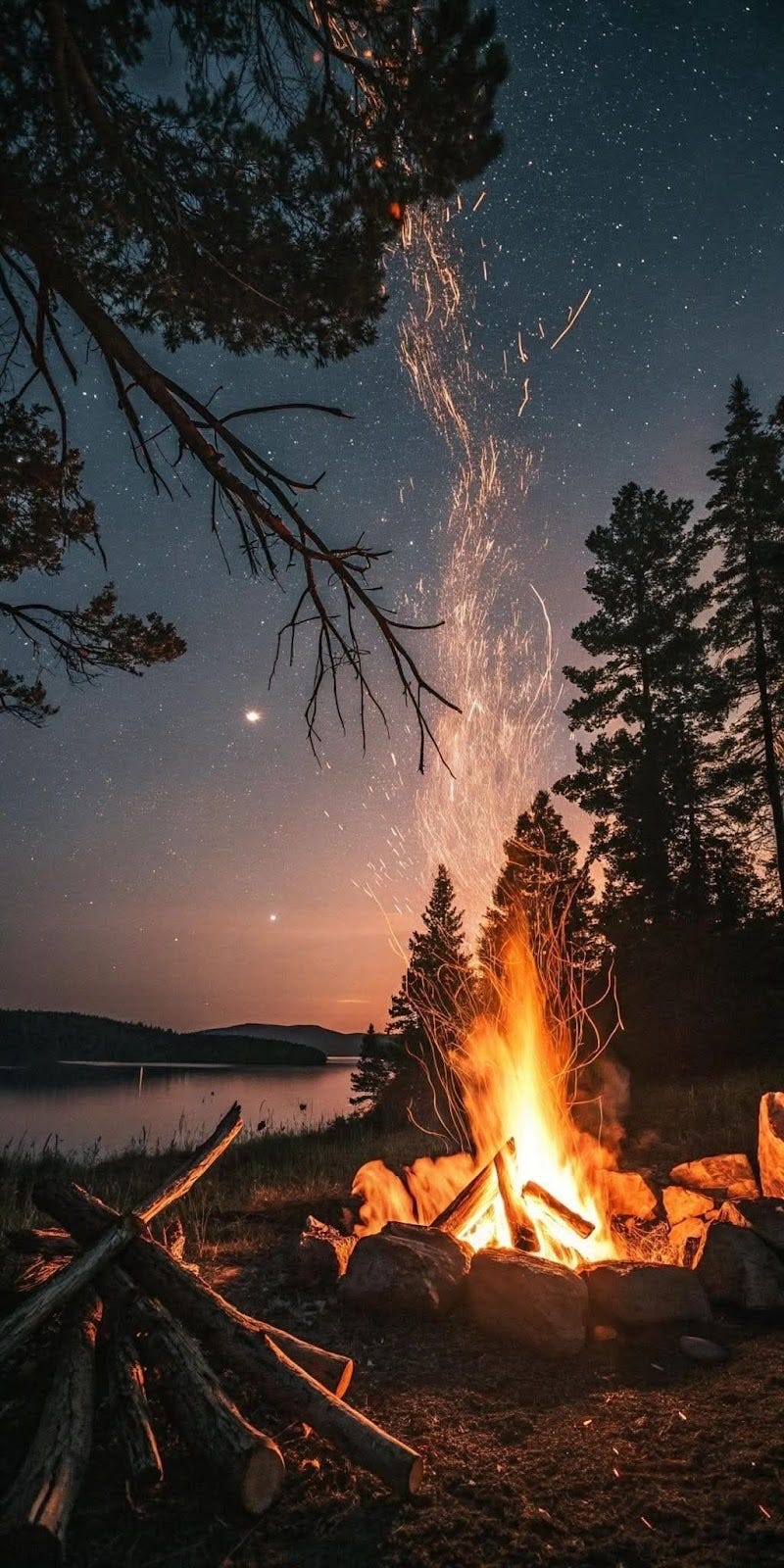
An hour later found him sitting a little ways back from the South river, the dark closing in, the water sending its coolness up the shore, a small fire burning in an old stone ring. His fingers were cold – they often were, even in LA – so he added a bit more wood and moved closer. There were some teens sitting around another fire a little ways down, laughing and camping out. A little further upstream, he caught sight of a couple by yet another fire. Making out. Not much had changed in twenty years.
But Bristlewood had deserved better.
He worked life into his fingers then picked up his guitar and played the long intro to Lost Knight. It had been the opening song from ‘Out of Time.’
“Don’t you dare make this about you,” a voice said.
He stopped, turning to see her standing just within the glow of the fire, still mostly wrapped in shadow. For a moment, Julie Kern looked like a living, breathing ghost of the girl he’d left. Young, unchanged. Ready to run with him, if she could.
They had met in Ms. Shaw’s piano class when they were ten years old. Over the next seven years they went from prickly rivals, to reluctant friends, to trusted bandmates... to something he could never honestly let go of, no matter how far he ran.
“I won’t,” he said. “But I’m glad you came.”
Julie stepped closer to the fire. The veil of memory burned off, and he saw her for the woman she was now. The decades had sharpened her eyes. They were still as clear and thoughtful as he remembered, but far more guarded, and this sharpness set the frame of her countenance, and indeed, her whole body. Yet, without question, she was more beautiful tonight than when he’d said goodbye. She was wearing the same oversized blue and green flannel she’d worn that night. It had been his. They had worked at the movie theater together their Junior year. He gave it to her one night walking her home, and she’d worn it every day thereafter.
“You’re glad I came,” she said with an almost dead monotone. “You’re glad I came?” her voice raised a notch. In a motion that seemed at once blindingly fast and painfully, awkwardly slow, she pulled the flannel off, wadded it up, and threw it in the fire. He watched it smoke and burn with twenty years of failed promise.
“Julie, I’m sorry,” he began to say.
But Julie wasn’t done. The hardest slap he had ever known stopped him cold.
“You’re sorry?!” she spat. “Ten years, I waited for you. Ten years, I believed you. ‘Julie, I love you. I just have to see if I can do this. If it works out, I’ll come get you. If it doesn’t, I’ll come back.’”
“I know what I said.”
“Yeah, and I know what I said,” she replied. “I said I’d wait. And I did.”
She wasn’t even trying to hold back the tears. They were well earned. For two years after he’d left, when Ryan could barely get a gig to pay for gas, he wrote and he called every week. When Mike found him and he cut his first album which hardly made a dent, he still wrote and called. Even when ‘Sixstring’ took off like rocket, he still thought of her. But little by little, the letters stopped. The schedule got too crowded. And then he was everywhere and nowhere in the world, and Julie was just the girl somewhere in the woods of Wisconsin.
“Where were you?” she asked quietly.
Ryan had no answer. Ten years ago, at the height of his fame, when you couldn’t turn on the radio without hearing Dying Day, while his town was in the throes of its own, he was too busy to come back for their ten year reunion. Too afraid of it.
Nothing had gone right since.
“I should have been here,” he said.
“I hate you.”
“You have every right to.”
Julie stared at him strangely for a moment, her dark hair moving in the breeze, but her face motionless. “Did you know my dad died in ’94?”
“I heard,” Ryan said. “Tommy told me when he was in LA.”
“Tommy,” she said wistfully. “Did he tell you he asked me to marry him before he moved away?”
Ryan shook his head. “Why didn’t you?”
Julie laughed a bit. “What kind of life would that have been? Both of us still in love with Ryan Westfall, each in our own way.” She bit her lip, as if realizing what she’d just said. “I was sorry to hear about your engagement,” she added.
“It wasn’t right,” he replied, “And I wouldn’t have been any good to her.”
“But now you think you can be good to Bristlewood, is that right? Swing in here like Robin Hood and give us all another decade of hope?”
Ryan waited before answering. “Julie, you told me not to make this about me, and I don’t want to. All I can say is I’ve been staring down the same dead end for a long time, and I miss...” he looked toward the river, listened to it, followed its line into the dark, then upward to see a slash of star-misted sky between the trees. He looked again at Julie. He could hear his voice all those years ago, the sound of a stupid 17 year old kid chasing rock n’ roll redemption but wanting to hold her hand at the same time. He’d let the miles stretch till they snapped. He’d let the ride steal his word. “I miss it all. And I want to help.”
Julie turned back to the fire.
“I thought ‘Out of Time’ was your best album,” she said after a moment.
Ryan laughed. “So, you’re the one.”
He could see her shake with a silent sob. “I carried that shirt around all this time.”
“I’m sorry, Julie. I’ve been trying to write it ever since I left.”
“I wasn’t finished,” she said. “I carried that shirt around all this time. I knew one day where it would end up. What I didn’t know is that I carried this, too.”
And suddenly the dead end ran straight on. Julie turned around and kissed him, her tears wet on his face, her arms pulling him the last long mile home.
A week later, Ryan listed his house in LA. A month later, he and Julie were engaged. A year later, they were writing music together.
Mike retired, happily.